

No products in the cart.
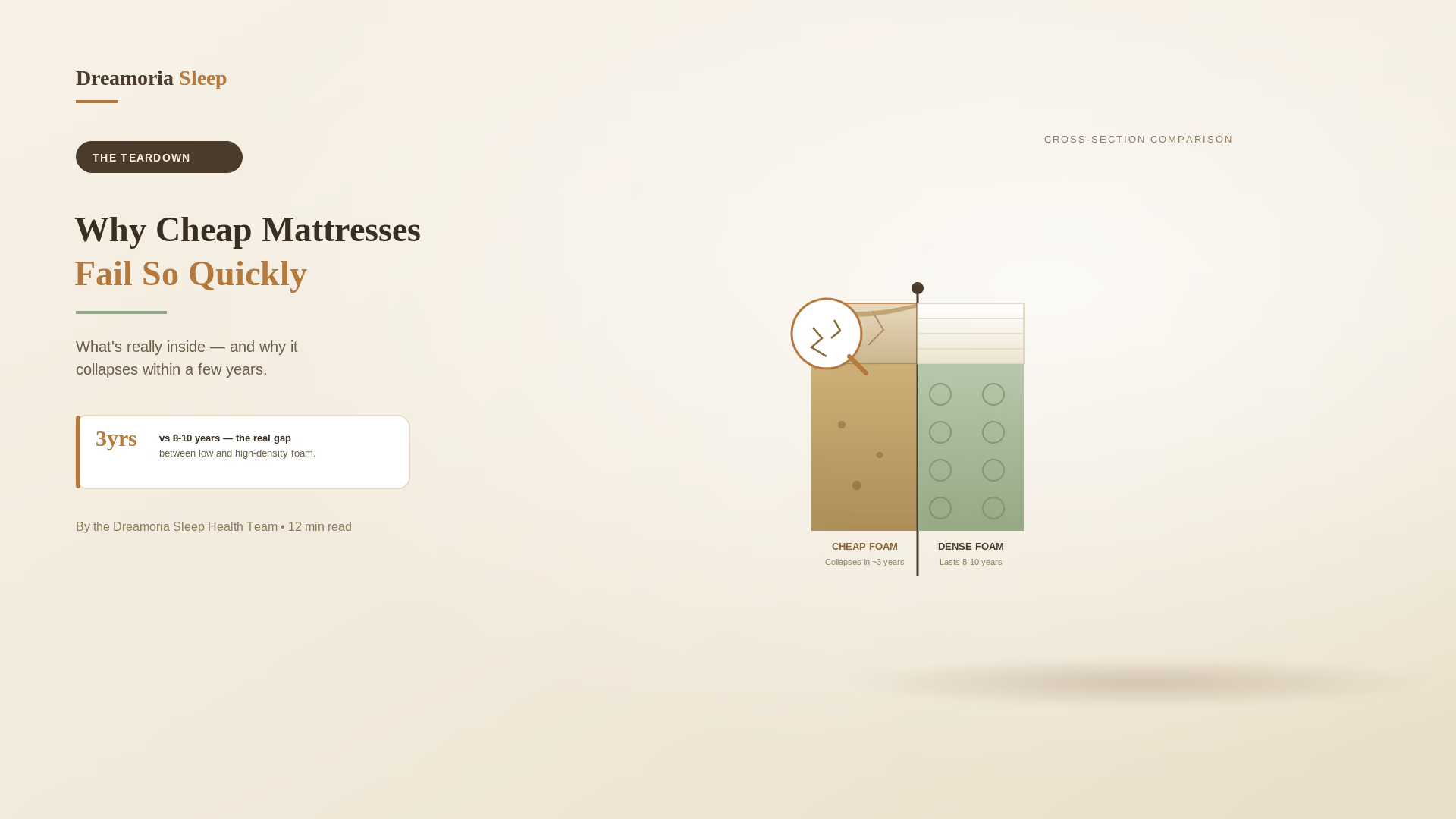
Why Do Cheap Orthopedic Mattresses Fail So Quickly?
Dreamoria Sleep — Buying Smart
Why Do Cheap Orthopedic Mattresses Fail So Quickly?
Understand why price actually matters for quality — not as a sales pitch, but as physics. Here’s exactly what’s cut when a mattress costs less, and what it costs you later.
By the Dreamoria Sleep Health Team • 12 min read • Updated July 2026
A cheap orthopedic mattress and an expensive one can look nearly identical in a showroom — same quilted cover, same “orthopedic support” label, same firm feel under your hand. The difference doesn’t show up until month eight or nine, when the middle third starts to soften, the edges stop holding your weight, and the support that sold you on it in the first place has quietly disappeared. This isn’t bad luck. It’s material science, and once you understand it, “why is this one three times the price” stops being a mystery.
1
The Real Reason: Foam Density, Not Foam Type
Two mattresses can use the exact same “memory foam” label and behave completely differently within a year. What actually determines durability is density — how tightly packed the foam’s cell structure is, measured in pounds per cubic foot. Low-density foam has thinner cell walls and larger air pockets. Under nightly body weight, those thin walls develop microscopic cracks, and eventually the internal structure collapses entirely — which is what you feel as a permanent dip where you sleep.
Higher-density foam costs more to manufacture because it uses more raw material per mattress. There’s no way around this cost — it’s not a markup, it’s the actual physical amount of material holding your body weight every night for years instead of months.
Foam Density vs. Expected Lifespan
Low-density foam2–3 years
Mid-density foam4–6 years
High-density foam7–10 years
Approximate ranges — actual lifespan depends on usage, body weight, and overall construction quality.
This is also why two mattresses can carry the same “orthopedic” or “medium-firm” label and behave completely differently after a year. Firmness on day one is a function of foam formulation — it can be tuned cheaply. Firmness on day 500 is a function of density, which cannot be faked or compensated for with clever design. A mattress that feels identical to a premium option in the shop can be built from foam that starts breaking down within months, simply because the manufacturer used less material to hit a lower price point.
2
What Gets Cut First When Price Drops
A mattress is built in layers, and cost-cutting almost always happens from the middle outward — the parts you can’t see or feel in a two-minute showroom test, but that carry your weight every night for years.
Budget Construction
Thin quilted cover
Low-density comfort foam (thin layer)
Low-density base foam, minimal support core
Quality Construction
Reinforced breathable cover
High-density comfort foam, zoned for pressure relief
Reinforced transition layer
High-density support core or pocket coils, reinforced edges
Notice that the visible parts — the cover, the quilting pattern, the first inch you press with your hand in a showroom — are nearly identical between budget and quality builds. That’s not an accident. Manufacturers know these are the details shoppers actually inspect, so they’re rarely where cost is cut. The layers that determine whether a mattress survives year three are buried underneath, invisible until you’re already sleeping on it every night.
3
Coil Gauge: The Spec Nobody Explains at the Till
If the mattress has springs, coil gauge matters just as much as foam density. Gauge refers to the thickness of the steel wire — counterintuitively, a lower gauge number means thicker, more durable steel. Cheap hybrids often use thinner, higher-gauge wire in fewer coils to cut cost, which means less consistent support and coils that lose their tension faster under regular use.
Coil count matters too, but only in combination with gauge — a mattress can advertise an impressively high coil count while still using thin, low-durability wire throughout. A lower count of properly gauged, individually pocketed coils will consistently outperform a higher count of thin, poorly tempered steel. This is one of the easiest specs for budget manufacturers to make sound impressive on paper while quietly cutting the quality that actually matters.
4
The Hidden Cost of Buying Cheap Twice
A cheap mattress doesn’t just fail sooner — it fails at your expense, repeatedly. Run the numbers over a decade and the “budget” option is rarely the cheaper choice.
Cost Over 10 Years
Budget Mattress (replaced every ~3 years)
3 purchases, 3 delivery waits, 3 disposal hassles
Quality Mattress (lasts 8–10 years)
1 purchase, 1 decision, years of consistent support
Illustrative comparison — actual costs vary by product and usage. Beyond the repeat spending, each replacement also means weeks of readjusting to a new surface, delivery logistics, and disposing of the old mattress — costs that never appear on a receipt but add up regardless.
“
A mattress that costs less but fails in three years isn’t a bargain — it’s three years of full price, paid twice as often.
— Dreamoria Sleep Health Team
5
Why Cheap Mattresses Feel Fine at First
This is where psychology matters as much as material science. New foam of any density feels supportive for the first few weeks — it hasn’t yet been compressed thousands of times, so even a low-density mattress can feel comparable to a premium one on night one. This creates a genuine cognitive trap: the early comfort confirms you made a smart, budget-conscious choice, so by the time real sagging appears months later, it’s easy to attribute it to “getting used to it” or an unrelated cause rather than the mattress itself.
There’s also a pricing-anchor effect at play. Once you’ve seen a mattress advertised at a steep discount, a fairly priced, honestly constructed mattress can feel expensive by comparison — even when the discounted one was never capable of lasting as long. Recognising this pattern is the first step to evaluating a mattress on its actual specifications, not on how good the deal feels in the moment.
Sunk cost thinking compounds the problem once sagging does appear. Having already spent money and time setting up a new mattress, most people delay replacing it, adding a pillow topper or simply adjusting their sleep position instead of admitting the purchase didn’t hold up. This is a completely understandable response psychologically, but it usually means living with disrupted sleep and gradually worsening pressure points for months longer than necessary, all to avoid confronting an earlier decision.
6
What to Actually Check Before Buying
1
Ask for the foam density spec
A brand confident in its build will publish this without hesitation.
2
Check the warranty length
Longer warranties usually reflect genuine confidence in durability, not just marketing.
3
Look for a genuine trial period
30+ nights gives your body time to reveal how the mattress actually performs.
4
Read reviews after 12+ months
Early reviews rarely capture sagging — search for feedback from long-term owners.
Every Dreamoria orthopaedic and hybrid mattress is built with higher-density foam and reinforced support cores specifically because these are the layers that determine whether a mattress lasts years or months. We’d rather explain the specification than hide behind a discount — because a mattress that quietly fails within a few years costs you more in disrupted sleep, replacement hassle, and repeat spending than a fairly priced one built to last ever will.
7
Common Questions
How long should a good orthopedic mattress actually last?
A well-constructed mattress with high-density foam and a reinforced support core typically lasts 7 to 10 years. Budget mattresses with low-density foam can begin sagging within 2 to 3 years.
Is a higher price always a sign of better quality?
Not automatically — some of the price gap is brand and marketing. But below a certain price point, higher-density materials simply aren’t financially possible, which is why extremely cheap mattresses share the same failure pattern regardless of brand.
Can a mattress topper fix a cheap, sagging mattress?
A topper can mask the feel temporarily, but it can’t restore a collapsed support core underneath. If the base has failed structurally, a topper is a short-term patch, not a fix.
What’s the single most important spec to check?
Foam density for all-foam and comfort layers, and coil gauge for hybrids. Together these two numbers predict durability more reliably than brand name or showroom feel.
Why does a mattress feel fine in the shop but sag at home?
Showroom testing involves a few minutes of pressure. Real degradation only shows up after thousands of hours of nightly compression, which is exactly the kind of wear a two-minute test can never reveal.
Does a more expensive mattress always mean higher density foam?
Not always — always check the actual published spec sheet rather than assuming price alone guarantees quality. Reputable brands will list density and coil gauge directly; if a retailer can’t provide these figures, treat that as a red flag in itself.
Buy Once, Sleep Well for Years
Take Dreamoria’s two-minute sleep quiz and get matched to a mattress built with the density and support that actually lasts.
© 2026 Dreamoria Sleep. All rights reserved.