

No products in the cart.
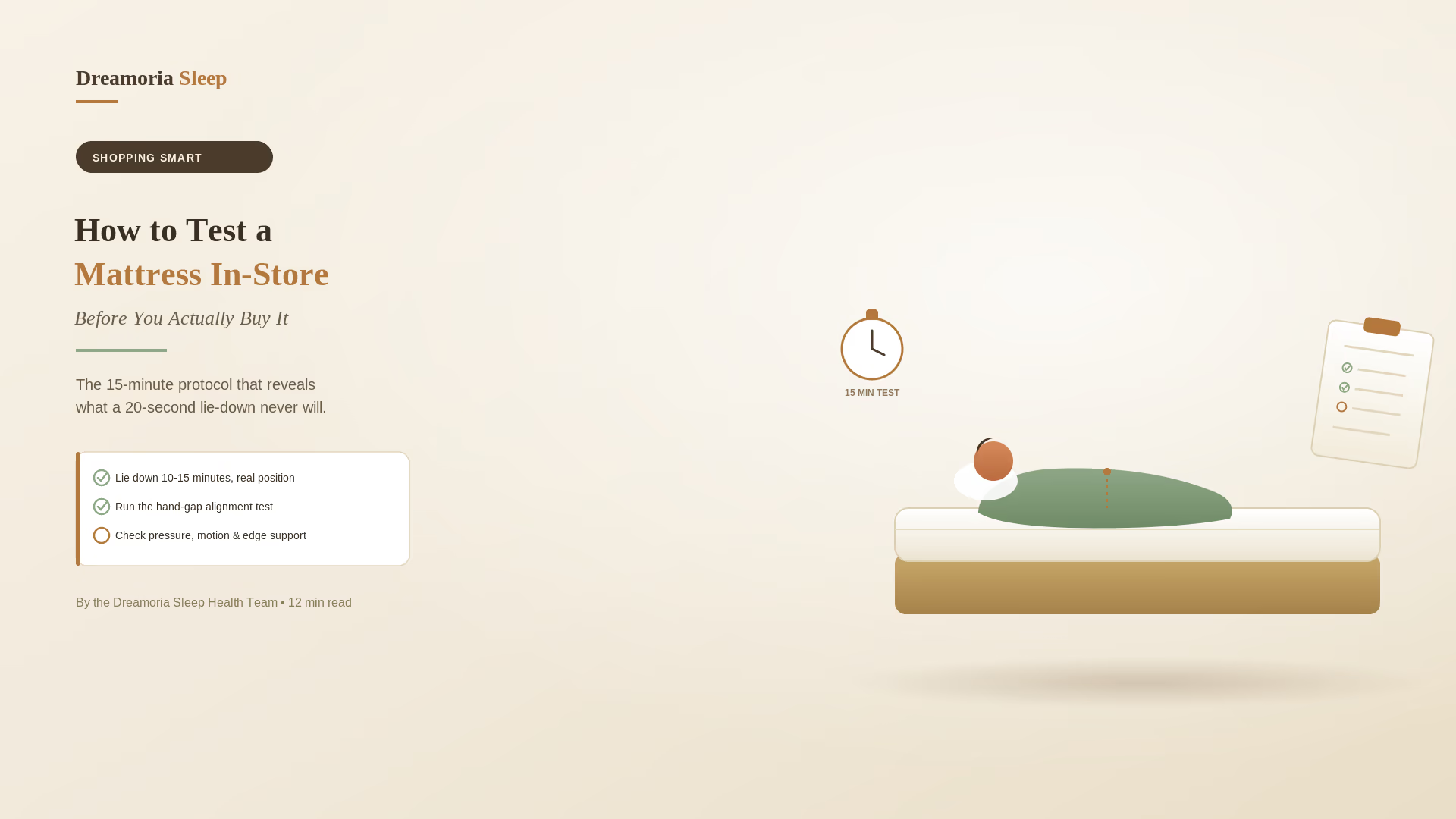
How to Test an Orthopedic Mattress in the Store Before Buying
Dreamoria Sleep — Shopping Smart
How to Test an Orthopedic Mattress in the Store Before Buying
A two-minute lie-down tells you almost nothing. Here’s the exact protocol to actually learn what a mattress will feel like in year two, not just minute two.
By the Dreamoria Sleep Health Team • 12 min read • Updated July 2026
Most people spend more time choosing a phone case than testing the mattress they’ll spend a third of their life on. A quick lie-down in your outdoor clothes, hands folded, for twenty seconds, tells you almost nothing about pressure relief, spinal alignment, or how a mattress will actually feel after fifteen minutes — let alone fifteen years. Testing an orthopedic mattress properly takes a bit more effort, but it’s the single most reliable way to avoid buying the wrong firmness, and it costs nothing extra. Here’s exactly how to do it.
As a sleep-health team, we see the same pattern constantly: people describe their mattress-buying regret not as “I chose the wrong brand,” but as “I didn’t actually know what I was feeling for.” That’s an information problem, not a bad-luck problem — and it’s entirely solvable with a structured test rather than a hopeful guess. The goal of everything below isn’t to make shopping complicated; it’s to replace a vague impression with specific, repeatable checks you can run on any mattress, in any showroom, in under fifteen minutes.
1
Before You Even Walk Into the Store
The test starts before you arrive. A few minutes of preparation makes every test afterward far more accurate.
1
Know your sleep position
Side, back, or front sleepers need different firmness — test accordingly, not however feels convenient in the shop.
2
Bring your own pillow
Pillow height changes spinal alignment significantly — a showroom pillow can throw off the whole test.
3
Wear loose, comfortable clothing
You need to lie naturally, not stay stiff in jeans and shoes.
4
Go when you’re not rushed
Give yourself at least 30–40 minutes across two or three mattresses, not five minutes on your lunch break.
It’s also worth deciding your budget range and shortlisting two or three mattresses before you go. Testing more than three in one visit tends to blur together — by the fourth or fifth mattress, most people can no longer tell them apart, which defeats the purpose of testing carefully in the first place. Quality over quantity applies here just as much as it does to the mattress itself.
2
The 15-Minute In-Store Protocol
Your body needs time to stop bracing and actually settle into a surface. Rushing this step is the single biggest reason people misjudge a mattress in the showroom.
Timed Testing Sequence
0–5 min
Lie still in your usual sleep position, eyes closed
5–8 min
Shift to your two other common positions
8–11 min
Sit against the headboard, check lower back support
11–15 min
Run the pressure, motion and edge tests below
This sequence matters because your muscles instinctively brace for the first minute or two on any new surface, especially in an unfamiliar, public setting. That initial tension can make a mattress feel firmer or less comfortable than it actually is. Giving yourself the full five minutes before judging anything is the single easiest way to get a more honest read, and it costs nothing but a little patience most shoppers skip entirely.
3
The Spinal Alignment Self-Check
This simple test tells you more about long-term support than anything a salesperson will say. Lie on your back and slide a hand into the gap between your lower back and the mattress.
Too Much Gap — Too Firm
Lower back unsupported
Snug Fit — Good Alignment
Spine stays neutral
If your hand slides in with obvious space to spare, the mattress is too firm for your lower back. If you can barely fit your hand at all, it may be too soft and letting your hips sink. A snug, even fit — where your hand meets gentle, consistent resistance along its length — is the sign to look for.
This test works because it approximates what a pressure map would show in a sleep lab, without any equipment. A neutral spine means the natural curve of your lower back is gently supported rather than flattened or exaggerated — and your hand is a surprisingly reliable stand-in for that measurement. Run it in every sleep position you regularly use, not just on your back, since alignment needs shift depending on posture.
4
Three More Tests Worth Doing
Pressure Point Check
After 5 minutes on your side, notice any sharp discomfort at the shoulder or hip. Mild cushioning is normal; a hard, focused pressure point is not.
Motion Transfer Test
Place a filled water bottle near where a partner would sleep, then roll over or sit down on your side. If it wobbles or tips, motion transfer is high — worth knowing if you share a bed.
Edge Support Test
Sit near the edge and shift your weight. A mattress with weak edge support will feel like it’s about to give way — a sign of a thin or unreinforced perimeter.
Run all three tests on your shortlisted mattresses in the same order, so you’re comparing like for like rather than relying on memory between showroom visits days apart. If possible, take brief notes on your phone after each one — firmness impression, any pressure points, how the edge felt — since first impressions fade quickly once you’ve tested a second or third option.
“
Twenty seconds on your back, fully clothed, tells you how a mattress feels for twenty seconds. Fifteen minutes in your real sleep position tells you how it will feel every night for years.
— Dreamoria Sleep Health Team
5
Why Showrooms Are Designed to Rush You
It’s worth understanding the psychology of the showroom itself. Bright lighting, a hovering salesperson, and the social awkwardness of lying down in public all push shoppers toward a fast decision — the opposite of what a proper test requires. This isn’t accidental; urgency and discomfort both shorten decision time, which works in the seller’s favour more than yours.
Knowing this in advance helps you push back on it. It’s entirely reasonable to ask a salesperson for space, to say you’re testing multiple mattresses and will take your time, or to return on a quieter day. A good retailer won’t rush a decision this significant — if one does, treat that pressure itself as useful information about what they’re not confident enough to let you evaluate slowly.
Limited-time discounts deserve the same scepticism. Genuine sales exist, but artificial urgency — a deal that “ends today,” a price that resets the moment you walk out — is a well-documented pressure tactic designed to short-circuit careful comparison. A mattress you’ll sleep on for years deserves a decision made on its own timeline, not one dictated by a countdown timer at the till, however convincing it looks in the moment.
6
Questions to Ask Before You Pay
→ What’s the foam density or coil gauge, in writing?
→ How many nights is the home trial period, exactly?
→ What’s covered under warranty, and for how long?
→ Is old mattress removal and delivery included?
→ Should I expect a “break-in” adjustment period?
→ What’s the exact return or exchange process if it doesn’t work out?
Write the answers down, or ask for them in writing before you commit to anything. A retailer confident in their product will answer every one of these without hesitation — vague or evasive answers to any of them are worth treating as a signal in themselves, regardless of how comfortable the mattress felt in the showroom.
7
Common Questions
How long should I actually lie on a mattress in-store?
At least 10 to 15 minutes, split across your usual sleep positions. Anything shorter doesn’t give your body time to settle and reveal real pressure points.
Is it awkward to spend that long testing a mattress in public?
It can feel that way initially, but it’s a completely normal part of shopping for a major purchase. Any reasonable retailer expects and welcomes it.
Can an in-store test really predict long-term comfort?
Not perfectly — a home trial period is still the most reliable test. But a thorough in-store check filters out mattresses that are clearly wrong for your body before you even get one home.
What if I can’t test in person at all?
Rely on a long, genuine home trial period instead — it’s a more accurate test than any showroom, since it covers real sleep over multiple nights rather than a few minutes.
Skip the Guesswork Entirely
Take Dreamoria’s two-minute sleep quiz and get matched to a firmness built for your body and position — backed by a genuine trial period.
However thoroughly you test in-store, remember that a showroom visit is still a preview, not the final verdict — your own bed, at home, over consecutive real nights of sleep, is what actually confirms whether a mattress is right for you.
© 2026 Dreamoria Sleep. All rights reserved.