No products in the cart.


Dreamoria Sleep • Couples Guide
Best Orthopedic Mattress for Couples With Different Firmness Needs
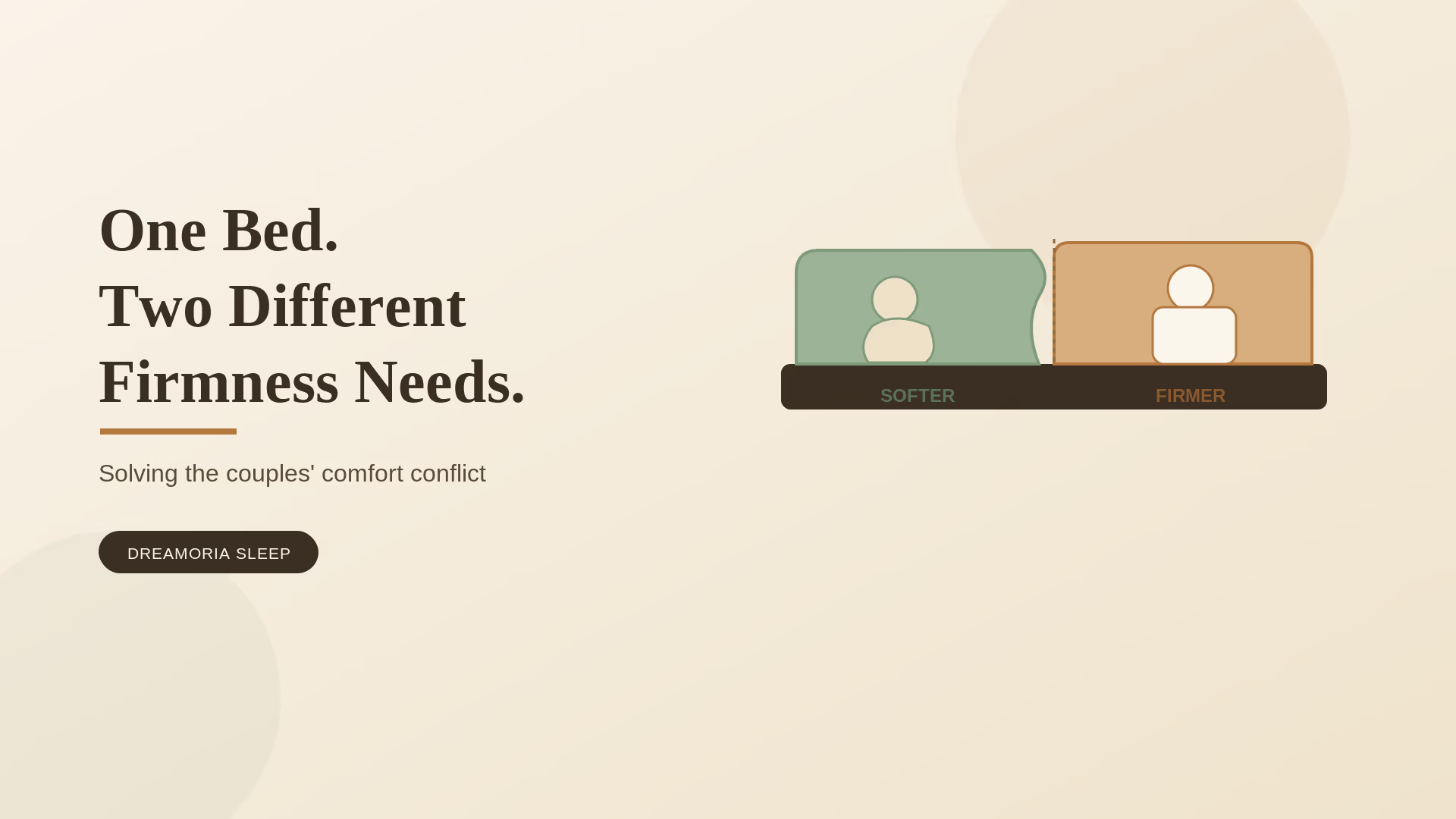
One of you wants soft. One of you wants firm. Here’s how to actually solve it, instead of one person quietly losing the argument every night.
The best mattress for couples with different firmness needs is almost always a medium-firm hybrid — its coil-and-foam construction gives a firmer partner real support while still letting a softer-preferring partner sink in at the shoulders and hips. A split king (two separate mattresses on one frame) solves extreme differences completely; a firmness-adjusting topper solves mild ones cheaply. Which one is right depends on how far apart your two preferences actually are.
It’s one of the most common, least talked-about sources of tension in a shared bedroom. Not snoring, not blanket-stealing — firmness. One partner sinks in and finally relaxes on a soft, plush surface. The other lies awake on that same surface feeling like their lower back is folding in half. Someone always ends up compromising, and “compromise” in mattress terms usually means one person sleeps well while the other quietly suffers for the sake of the relationship.
It’s worth naming the pattern that quietly builds around this. One partner starts sleeping badly, doesn’t want to make a fuss, and adapts. Months later they’re waking up stiff, sleeping less deeply, and not really connecting it back to the mattress — it’s just become background discomfort they’ve stopped mentioning. If that sounds familiar, the disagreement was never resolved. It was just absorbed by whoever cared less about winning it.

When the mattress actually fits both of you, sharing a bed stops being a nightly compromise.
Why you two disagree in the first place
Firmness preference isn’t a personality quirk — it’s driven by three physical factors: body weight, sleep position, and where you carry pressure. A heavier partner sinks deeper into any given mattress than a lighter one, so the same surface can feel medium to one person and too soft to the other. A back or stomach sleeper generally needs firmer support to keep the hips from sinking out of alignment, while a side sleeper needs more give at the shoulder and hip to avoid pressure points. Put a side-sleeping, lighter partner next to a back-sleeping, heavier one, and you have two genuinely different physical needs sharing one surface — which is exactly why “just meet in the middle” satisfies neither of you.
The three real solutions — and how they compare
| Solution | How it works | Best for |
|---|---|---|
| Medium-firm hybrid | One mattress engineered to sit in the sweet spot most bodies adapt well to, with a responsive comfort layer | Couples whose preferences are close but not identical |
| Split king setup | Two separate mattresses of different firmness, side by side on one frame | Couples with dramatically different needs who don’t mind a centre seam |
| Firmness-adjusting topper | Added on top of your existing mattress to shift how one or both sides feel | Couples not ready to replace the whole mattress yet |
There’s no single “correct” answer — it depends on how different your needs actually are, and how much disruption you’re willing to accept for a perfect individual fit. A split king solves the problem completely but means sleeping next to a seam, and changes how you share warmth and closeness through the night. A topper is the cheapest fix but only shifts feel by a small margin, so it works for mild differences, not opposite extremes. For most couples, a well-built medium-firm hybrid solves the disagreement without introducing a new one.
Why hybrid, specifically, tends to win this argument
A hybrid mattress pairs a supportive coil base with a comfort layer on top, and that combination suits exactly the kind of disagreement most couples have. The coil base gives the firmer partner the underlying support they’re after, so they don’t feel like they’re sinking. The comfort layer on top gives the partner who wants softness enough give at the shoulders and hips that they’re not lying on a hard surface all night. Because the two layers do different jobs, a hybrid satisfies two different body types and sleep positions far better than an all-foam or all-spring mattress, which tends to feel uniformly soft or uniformly firm no matter who’s lying on it.

The layered construction underneath is what actually does the work of satisfying two different bodies.
There’s also the motion transfer question, which matters more for couples than solo sleepers. Every time one of you shifts position, rolls over, or gets up during the night, that movement can travel across the mattress and disturb the other person. A hybrid’s individually wrapped coils and layered foam absorb that movement locally, rather than letting it ripple across the whole surface — which matters just as much for a couple’s sleep quality as firmness itself does.
Why we point couples toward Hybrid mattresses over Orthopaedic
100-night sleep trial
Hybrid mattresses come with a 100-night trial, so you and your partner can genuinely test whether it resolves your disagreement before committing long-term. This trial doesn’t apply to our Orthopaedic range — the risk of getting it wrong sits entirely with a Hybrid purchase, not you.
Dual-need support
The layered coil-and-foam construction is specifically suited to two different bodies and sleep positions sharing one surface, which is the exact problem this guide is solving.
Talking about it without it turning into an argument
Firmness disagreements have a way of turning into something bigger than they need to be, because they can start to feel like a referendum on whose comfort matters more in the relationship. It helps to reframe the conversation early: this isn’t about whose preference “wins,” it’s a shared problem with a genuine engineering solution. Approaching it that way — two people solving something together, rather than negotiating a compromise where someone loses — lowers the emotional stakes considerably and makes it much easier to test mattresses together with an open mind instead of defending a position.
It also helps to separate two questions that often get tangled together: what each of you individually needs physically, and what you’re both willing to accept for the relationship’s sake. Being explicit about which one you’re discussing — “I need firmer support for my back” versus “I’d rather not sleep on a seam” — keeps the conversation practical instead of it quietly becoming about who’s being more reasonable.
How to actually test it together before you buy
Don’t test a mattress alone and assume your partner will feel the same way — you won’t. Lie down together, in your normal sleep positions, for a full five minutes each, not thirty seconds. Pay attention to whether your hips and shoulders feel supported without digging in, and whether you can feel your partner moving when they shift position. If you can both stay in your usual positions comfortably for the full five minutes without needing to adjust, that’s a far more reliable signal than how the mattress feels the moment you sit down on the edge of it in a showroom.
A word of honesty
No single mattress will feel identically perfect to two different people every single night. The goal isn’t a mattress that erases both of your preferences — it’s one that gets you both close enough to great support that neither of you is quietly suffering for the other’s comfort.
One more practical point: your needs as a couple aren’t fixed forever. Body weight changes, injuries happen, pregnancy changes sleep position and pressure needs, and preferences genuinely shift over the years you’ll spend sharing that mattress. This is another reason a trial period matters more for couples than solo buyers — you’re not just testing today’s preferences, you’re finding out whether the mattress has enough range to keep working for both of you as those preferences shift.
Frequently asked questions
Is a split king the only real fix for very different firmness needs?
It’s the most complete fix for extreme differences, but many couples find a medium-firm hybrid closes the gap enough without needing separate mattresses and a visible centre seam.
Can a mattress topper really solve different firmness preferences?
It can help with mild differences by softening or firming one side slightly, but it won’t bridge a large gap between someone who wants very soft and someone who wants very firm.
Why does a hybrid suit couples better than memory foam?
Memory foam alone tends to feel uniformly soft for everyone on it, which works for one preference but not two. A hybrid’s coil-plus-foam layering can satisfy both a firmer and a softer preference on the same surface.
How long should we trial a new mattress together before deciding?
Give it several weeks minimum. Your bodies need time to adjust to a new surface, and a 100-night trial exists precisely so you’re not forced to decide too early.
Stop compromising on sleep, together.
Take our two-minute sleep quiz as a couple and find the hybrid mattress that works for both of your bodies — risk-free for 100 nights.
Comments are closed