

No products in the cart.
Does Mattress Firmness Really Matter for Spine Health? | Dreamoria Sleep
Dreamoria Sleep — The Science of Support
Does Mattress Firmness Really Matter for Spine Health?
“Firm is best for your back” has been repeated so often it sounds like fact. Here’s what the research actually shows — and where that advice gets it wrong.
By the Dreamoria Sleep Health Team • 12 min read • Updated July 2026
For decades, the standard advice for back pain was simple: buy the firmest mattress you can find. It made intuitive sense — firm sounds supportive, soft sounds like it lets you sink. But sleep and orthopedic research over the past two decades tells a more precise story, and it doesn’t point to “firmer is always better.” It points to a specific, evidence-backed sweet spot that most extremely firm mattresses actually miss.
As both a psychological and physical question, this matters more than a shopping preference. The mattress you sleep on shapes your spine’s position for roughly a third of your life, and the wrong assumption — chasing maximum firmness because it “feels supportive” — can quietly work against the very outcome you’re trying to achieve. Understanding the actual mechanism behind spinal support, rather than relying on instinct or outdated advice, changes how you should shop entirely.
1
What the Research Actually Shows
Multiple clinical studies comparing mattress firmness levels in people with chronic low back pain have converged on a remarkably consistent finding: medium-firm surfaces outperform both very soft and very firm ones. One widely cited clinical trial found that participants sleeping on medium-firm mattresses reported significantly greater improvements in pain and disability than those on firm mattresses, over several weeks of use. Orthopedic literature reviews spanning decades of research reach a similar conclusion — extremes in either direction tend to perform worse than a well-supported middle ground.
This is a meaningfully different message from “buy the firmest mattress available,” and it’s worth understanding why the evidence points this way. Researchers measuring outcomes like pain intensity, sleep quality, and morning stiffness across firmness levels consistently find the same pattern: results improve as firmness increases from soft toward medium, then plateau or decline again as surfaces move from medium-firm toward very firm. That shape — improvement, peak, decline — is the key detail that “just buy firm” advice leaves out entirely.
It’s also worth noting what these studies are actually measuring. Firmness itself isn’t the outcome researchers care about — it’s a proxy for two underlying mechanical factors: how well a surface distributes body weight across contact points, and how well it maintains the spine’s natural curve throughout the night. Medium-firm surfaces tend to score best on both simultaneously, which is the real reason the research consistently favours that range rather than firmness for its own sake.
2
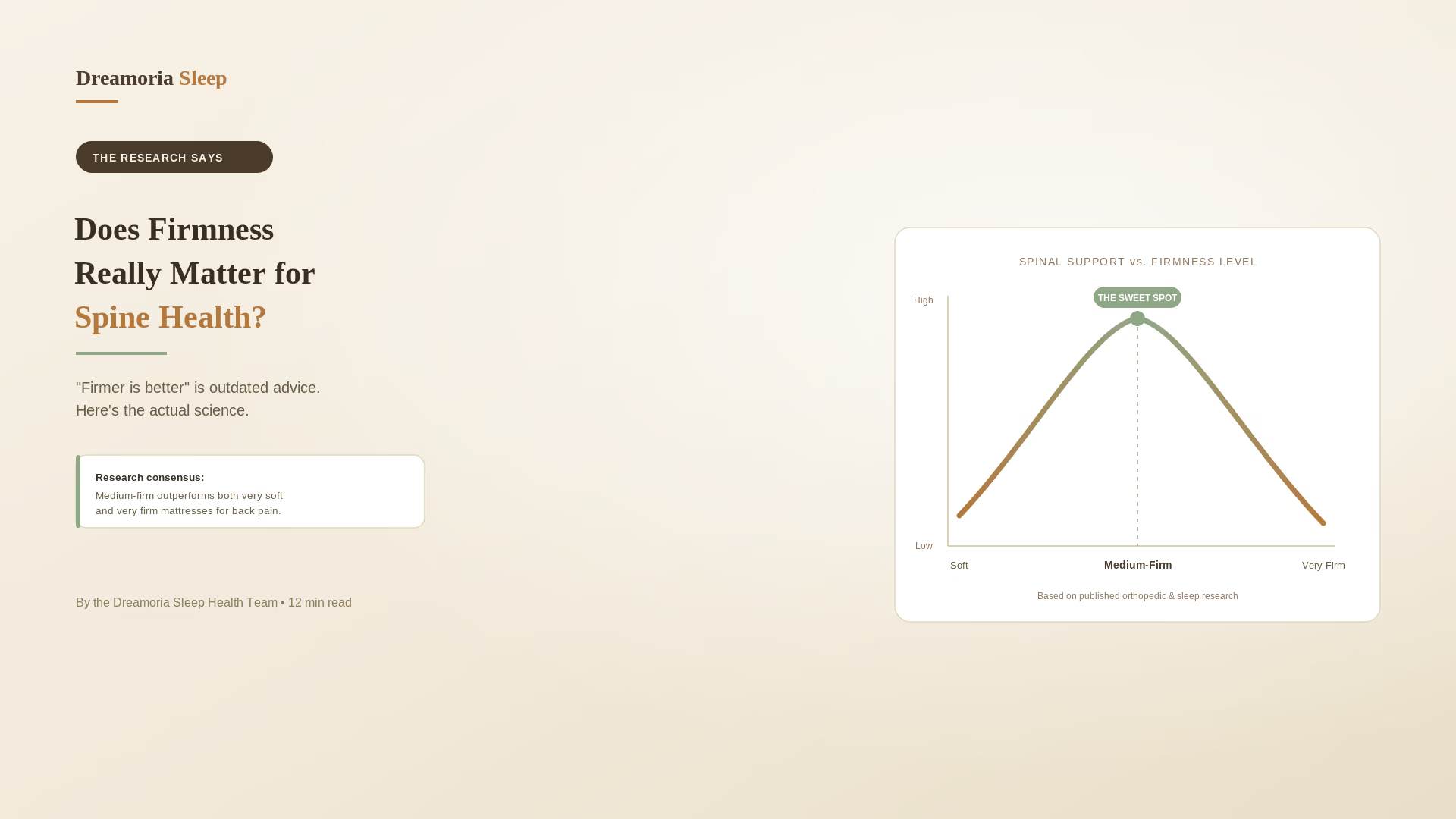
The Firmness “Sweet Spot” Curve
Spinal support doesn’t improve in a straight line as firmness increases — it rises, peaks around medium-firm, and then declines again as a surface becomes too hard to cushion the body’s natural curves.
Spinal Support Outcome vs. Firmness Level
Both extremes reduce spinal support quality — the peak sits at medium-firm, not maximum firmness.
Notice that both tails of this curve represent a real, measurable decline — not just a matter of personal comfort preference. That distinction matters, because it reframes the choice: this isn’t “soft versus firm, pick whichever feels nicer,” it’s a mechanical question with an evidence-backed answer that happens to sit in the middle rather than at an extreme.
3
What Happens at Each Extreme
Too Soft — Spine Sags
Hips sink, lumbar curve reversed
Too Firm — Pressure Points
Shoulders and hips unsupported
Medium-firm support cushions pressure points while keeping the spine’s natural curve intact — the mechanism the research consistently points to, regardless of which specific brand or product is being tested.
On the too-soft end, the hips — the heaviest part of the body — sink deeper than the shoulders and legs, pulling the lumbar spine out of its natural curve and into a position closer to a hammock than a straight line. On the too-firm end, the surface refuses to compress at all under the shoulder and hip, so those two points absorb the full force of body weight without any cushioning, which is what produces the sharp, localised pressure that triggers frequent repositioning through the night.
4
“Medium-Firm” Still Shifts With Sleep Position
The research consensus around medium-firm is a population-level average — individual sleep position moves the ideal point slightly within that range.
| Sleep Position | Ideal Range | Why |
| Side sleepers | Medium-soft to medium | Extra cushioning needed for shoulder and hip |
| Back sleepers | Medium-firm | Keeps the lumbar curve supported without sagging |
| Front sleepers | Firm | Prevents the hips sinking and arching the lower back |
“
The research doesn’t say firmer is better. It says a spine supported without being flattened or pressured is better — and that happens in the middle of the scale, not at either end.
— Dreamoria Sleep Health Team
5
Why “Firmer Is Healthier” Became Common Wisdom
This is where psychology explains something the research alone doesn’t. A firm surface offers an immediate, tangible sensation of “support” — you can feel yourself resting on top of something solid rather than sinking. That sensory feedback is easy to interpret as spinal support, even when a too-firm surface is actually failing to cushion pressure points and creating new tension elsewhere.
Older medical guidance also leaned firm as a default, largely because it was safer advice to give broadly before individualized, position-specific research existed. That guidance has since been revised, but the original advice persisted in general knowledge long after the research behind it had moved on — a common pattern with health advice that becomes conventional wisdom before being updated.
There’s a familiar psychological shortcut at work here too: firmness is easy to perceive immediately, while proper spinal alignment is not something most people can consciously feel in the moment. When one factor is instantly obvious and the other is subtle, people naturally optimise for the one they can sense — even when it isn’t the one that actually matters most. This is exactly why relying on showroom instinct alone, without understanding the underlying research, tends to steer shoppers toward the wrong end of the firmness scale.
6
What the Research Doesn’t Tell You
Honesty matters here, and it’s worth stating plainly: “medium-firm” is a research average across large groups of people, not a guaranteed answer for every individual spine. Body weight, existing spinal conditions, and personal sleep position all shift the ideal point within that range, sometimes meaningfully. Firmness studies are also a proxy for what actually matters mechanically — spinal alignment and pressure distribution — so two mattresses both labelled “medium-firm” can still perform differently based on their internal construction, not just their firmness rating on a box.
The practical takeaway isn’t to chase a specific number on a firmness scale. It’s to use medium-firm as a well-evidenced starting point, then adjust based on your own sleep position, body weight, and how your spine actually feels after a genuine trial period — the same combination of science and self-assessment that underpins good orthopedic guidance generally.
It’s also worth remembering that firmness ratings aren’t standardised across brands. One manufacturer’s “medium-firm” can feel noticeably different from another’s, because there’s no universal scale enforced across the industry — which is exactly why the hand-gap alignment check and a proper trial period matter more than trusting a label alone. Research points you toward the right neighbourhood; your own body still has to confirm the exact address.
7
Common Questions
Is a firm mattress ever the right choice?
Yes, particularly for front sleepers or heavier body weights, where extra firmness helps prevent the hips sinking too far. It’s not universally correct, but it’s not wrong for everyone either.
Does this research apply to people without existing back pain?
Much of the strongest research focuses on people with chronic low back pain, but the underlying mechanism — pressure distribution and spinal alignment — applies to healthy spines too, as a preventative factor.
How do I know if “medium-firm” is right for my body?
Use it as a starting point, then judge based on your sleep position and how your spine feels after a proper trial period rather than the label alone.
Can firmness alone fix back pain?
It can meaningfully reduce mechanical strain from sleep, but firmness is one factor among several. Persistent or severe pain still warrants a medical evaluation alongside any mattress change.
Find Your Evidence-Based Firmness
Take Dreamoria’s two-minute sleep quiz and get matched to the firmness range your body and position actually need.
This article summarises general research trends and is for informational purposes only — it is not a substitute for personalised medical advice. If back pain persists despite a supportive mattress, a doctor or physiotherapist remains the right next step.
© 2026 Dreamoria Sleep. All rights reserved.