

No products in the cart.
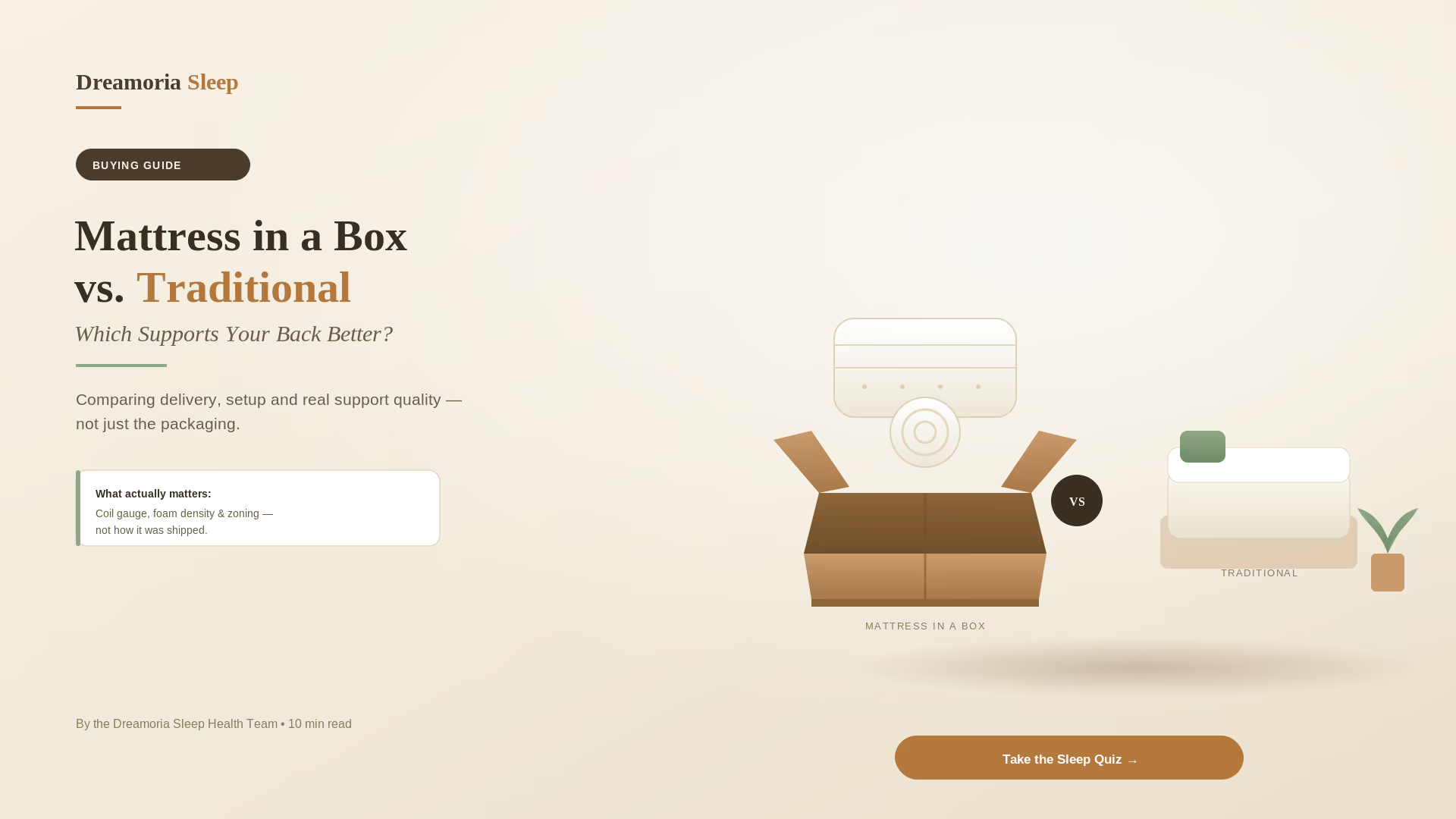
Mattress in a Box vs. Traditional: Which Supports Your Back Better?
Dreamoria Sleep — Buying Guides
Mattress in a Box vs. Traditional: Which Supports Your Back Better?
Compressed and rolled, or delivered flat by a two-person crew — the delivery method gets all the attention, but it’s not what determines whether a mattress actually supports your spine. Here’s what really matters.
By the Dreamoria Sleep Health Team • 10 min read • Updated July 2026
“Mattress in a box” describes packaging and delivery, not the mattress itself — yet it’s become a stand-in for an entire debate about quality. Traditional mattresses are delivered flat and assembled in-room; boxed mattresses are compressed, rolled, and expand once opened. Both methods can house identical construction underneath. The real question isn’t how it arrived at your door — it’s what’s inside it, and whether compression during shipping changes how well it supports your back. This guide breaks down exactly that.
1
What “Mattress in a Box” Actually Means
A boxed mattress is manufactured the same way as most modern mattresses, then compressed under pressure, rolled tightly, and vacuum-sealed into a box small enough to carry upstairs alone. Once unwrapped, it re-expands to full size over a few hours. Traditional delivery skips the compression step entirely — the mattress arrives at full size, usually requiring a van and often a two-person delivery team to carry it into the room.
Both approaches can use the exact same internal materials: pocket springs, memory foam, latex, or a hybrid combination. Compression is a shipping method, not a construction category — which is why comparing “boxed” against “traditional” only makes sense once you separate delivery convenience from the construction underneath.
Delivery Experience, Side by Side
Mattress in a Box
Compressed, rolled, shipped in a compact box. Usually carried in and unboxed by one person, expands within 24–72 hours.
Best for: upper-floor flats, narrow staircases, solo setup
Traditional Delivery
Delivered at full size, typically by a two-person crew who carry it directly into the bedroom and can remove your old mattress.
Best for: ground-floor access, wanting old mattress removed same day
2
Does Compression Actually Damage Support?
This is the concern behind almost every “boxed vs. traditional” question, and it deserves a direct answer: for a well-manufactured mattress, short-term compression during shipping does not meaningfully degrade support. Modern foams and pocket springs are engineered specifically to withstand compression and return to their original shape and firmness once unrolled.
Where problems do appear is with lower-quality foam that was never designed for compression cycles — it can lose some resilience and feel softer or uneven after unboxing. This is a manufacturing quality issue, not an inherent flaw of the boxed format itself. A well-built hybrid or orthopaedic mattress will fully recover its support profile within the expansion window, typically 24 to 72 hours.
Support Recovery After Unboxing
Unboxed6 hrs24 hrs48–72 hrs (full support)
Well-manufactured foam and pocket springs return to full designed firmness within 2–3 days — well within most brands’ trial periods.
3
What Actually Determines Back Support
Delivery method has no bearing on the four properties that determine spinal support: alignment, pressure relief, edge support, and motion isolation. Those are governed entirely by internal construction — the coil gauge, foam density, and zoning — not by whether the mattress travelled to you rolled or flat.
Coil Gauge & Zoning
Determines firmness consistency and lumbar support, regardless of packaging.
Foam Density
Higher-density foam resists sagging over years, boxed or not.
Layer Construction
How support and comfort layers are stacked affects alignment more than shipping.
Edge Reinforcement
Foam encasement or steel edge coils — a construction choice, not a delivery one.
4
Head-to-Head: Practical Differences That Do Matter
While support quality is determined by construction rather than delivery, a handful of practical differences are genuinely tied to the format itself.
| Factor | Mattress in a Box | Traditional Delivery |
| Setup effort | Low — one person can carry and unbox | Higher — often needs two people |
| Time to full firmness | 24–72 hours to fully expand | Immediate — no expansion needed |
| Old mattress removal | Rarely included | Often included same-day |
| Access to upper floors | Easy — fits through most doorways and stairwells | Can be difficult in narrow stairwells or lifts |
“
Ask what’s inside the mattress, not how it got to your door. The box is a delivery method — the coils and foam underneath are what your spine actually rests on.
— Dreamoria Sleep Health Team
5
How to Choose Based on Your Back, Not the Box
1
Check the construction, not the packaging
Ask about coil count, foam density, and zoning regardless of delivery type.
2
Give a boxed mattress its full expansion window
Judge firmness after 72 hours, not the first night.
3
Confirm the trial period length
You need enough nights to properly test spinal alignment, not just unbox day.
4
Weigh practicality against preference
Narrow stairs or solo setup favour boxed; wanting old mattress removed favours traditional.
Dreamoria ships every mattress compressed and rolled in recycled cardboard — the same hybrid and orthopaedic construction used across our full range, engineered to hold its designed firmness through compression and expand to full support within days of unboxing.
6
Common Questions
Is a boxed mattress lower quality than a traditional one?
Not inherently. Quality comes from coil gauge, foam density and construction — both delivery formats can house premium or budget builds.
How long should I wait before judging firmness?
Give a boxed mattress at least 48–72 hours to fully expand before forming an opinion on support.
Does compressing a mattress shorten its lifespan?
No, provided it’s manufactured for compression. Reputable brands test their foams and springs specifically for this shipping method.
Which option is better for bad backs?
Neither format wins by default — a well-constructed boxed hybrid can support your back just as well as a traditional one. Match firmness and zoning to your body and sleep position instead.
Not Sure Which Support Level Is Right for You?
Take Dreamoria’s two-minute sleep quiz and get matched to the mattress that actually supports your spine — delivered straight to your door.
© 2026 Dreamoria Sleep. All rights reserved.